terça-feira, 24 de novembro de 2026
GREVE GERAL DA JUVENTUDE EUROPEIA CONTRA A GUERRA E A AUSTERIDADE
Uma reportagem de Ana Vracar dá conta das numerosas manifestações (ver abaixo) que se estenderam por toda a Europa, contra o serviço militar obrigatório, as despesas com equipamentos militares, as restricções nos orçamentos da educação e o empobrecimento da população, pela viragem dos países europeus da OTAN para preparação duma guerra contra a Rússia. Tanto os pais dos alunos como os professores, através dos seus sindicatos, estiveram em muitos sítios, ao lado dos jovens.
A mobilização da juventude contra a guerra é a maior esperança, de momento, de que não rebente uma guerra generalizada, por alargamento da guerra na Ucrânia onde, há quase 5 anos, russos e ucranianos se batem brutalmente, com o apoio ativo dos países da OTAN ao lado ucraniano.
More than 50 student organisations in 27 European countries launched an international strike against war and militarisation on Friday, 20 November, drawing a million young people onto the streets. Students issued joint demands, including an end to rearmament and all forms of conscription, investment in education and social services, and solidarity with oppressed peoples around the world. They also declared resistance to growing authoritarian trends in the region. “We are protesting to claim our right to a better future, and we are aware that if we stand united, no one will be able to stop us from taking it,” said Alessandro Di Miceli from the Italian organisation Rete della Conoscenza. Actions took place in Norway, Sweden, Finland, Poland, Romania, Turkey, Greece, Croatia, Hungary, Slovakia, Austria, the Czech Republic, Germany, Denmark, the Netherlands, Belgium, Ireland, Italy, Britain, France, Switzerland, Spain, Portugal, Malta, and Slovenia, among others. “From the right to education to the right to housing, from the struggle against the rising costs of living and the climate crisis to the fight against militarisation and rearmament, specific demands may differ from country to country but are all deeply connected to each other,” Di Miceli said. Attacks on education funding One concern shared by student groups across the region is the precarious state of public education. For almost two months, high school and university students in France have led massive protests and occupations against austerity measures imposed during Emmanuel Macron’s presidency. Similar policies took root elsewhere too. In Britain, Prime Minister Andy Burnham’s administration recently announced cuts to student welfare and support while planning to invest billions in the military. “While the government says it doesn’t have the money to invest in education or opportunities for young people without cutting welfare and potentially pushing hundreds of thousands of young people into poverty, it is right now spending an extra £15 billion a year on the military,” Stop the War’s Shabbir Lakha wrote. Teachers and parents protested side by side with youth organisations in many cities, supporting their concerns. Still in England, the National Education Union (NEU) published a statement on planned school funding cuts on the day of the international youth strike. The union found that mainstream school funding in England will be slashed by £1.2 billion (USD 1.57 billion) in cash in 2027-28. The cuts will affect approximately 11,000 schools in England, the NEU pointed out—many of them in the poorest parts of the country, including Hackney, Southwark and Tower Hamlets in London. “Hackney and Tower Hamlets have the highest child poverty rates in the UK: half of their children live in poverty once housing costs are paid,” NEU general secretary Daniel Kebede warned.
Students refuse the return of conscription. Another concern widely voiced among student groups is the return of military conscription. In Germany, more than 50,000 pupils and students organised their fifth school strike in a year. The German government plans to build Europe’s “strongest conventional army” in a matter of years while slashing welfare and social security, with the youth insisting they will not be part of this scenario. Similarly, in Belgium—including in Ghent, Brussels, Leuven, Liège, and Antwerp—young people tore up letters issued by the Ministry of Defence regarding military service. In Slovenia, the Rosa Collective described how thousands of students attended a recent arms fair as part of their “active citizenship” curriculum while structural needs remain unaddressed. “The military is targeting rural vocational and technical high schools,” the group wrote. “They aim to recruit young people from socially disadvantaged backgrounds, offering them money and adventure.” Noting that Israeli arms companies Rafael and Israel Aerospace Industries appeared basically next door to the location visited by students, Rosa Collective warned that “young people are being recruited in secondary and primary (!) schools while some faculties and institutes are becoming incubators for the development of technologies for military use.” Convergence with housing and cost-of-living campaigns In Italy, Spain, and Portugal, the student strikes echoed mass mobilisations for housing and general strikes against the cost-of-living crisis. A national strike called by the mainstream trade union confederation CGIL was ongoing as students took to the streets in Italy, with progressive student collectives calling on the public to embrace a more ambitious agenda and support new mobilisations by grassroots unions on 12 December. In Spain, protesters cited the 11 November general strike as an inspiration. “We had an amazing strike last 11 November, with more than 400,000 people marching only in Barcelona,” a spokesperson for Sindicat d’Estudiants told Breakthrough News. “And we said that day that this was not the ending of anything. We said that the demonstrations, that the strike had to keep going. And this is what we are doing today.” “We are determined to continue organising and mobilising in the months ahead, until these demands become reality,” Shabbir Lakha emphasised in a statement by the Youth Strike Coalition. “The ruling classes of our countries should begin to worry, because this 20 November will only be the beginning. We will keep standing together as youth to fight for our future, not their wars.” |


segunda-feira, 23 de novembro de 2026
FOLKLORE DA AMÉRICA LATINA [Segundas-f. musicais, nº85]
Na sua diversidade, a música dos países latino-americanos - do México ao Caribe e da Amazónia à Patagónia - tem características comuns: nas formas musicais, nas vozes, nos rítmos ...
Não é meu objetivo percorrer a música deste sub-continente Latino Americano, em toda a sua diversidade; seria impossível! Mas, posso dar alguns exemplos.
Estou convencido de que eles serão do agrado de grande parte dos meus leitores.
Vídeos: música boliviana (1ª), peruana (2ª), mexicana (3ª), cubana (4ª) e chilena (5ª)
domingo, 22 de novembro de 2026
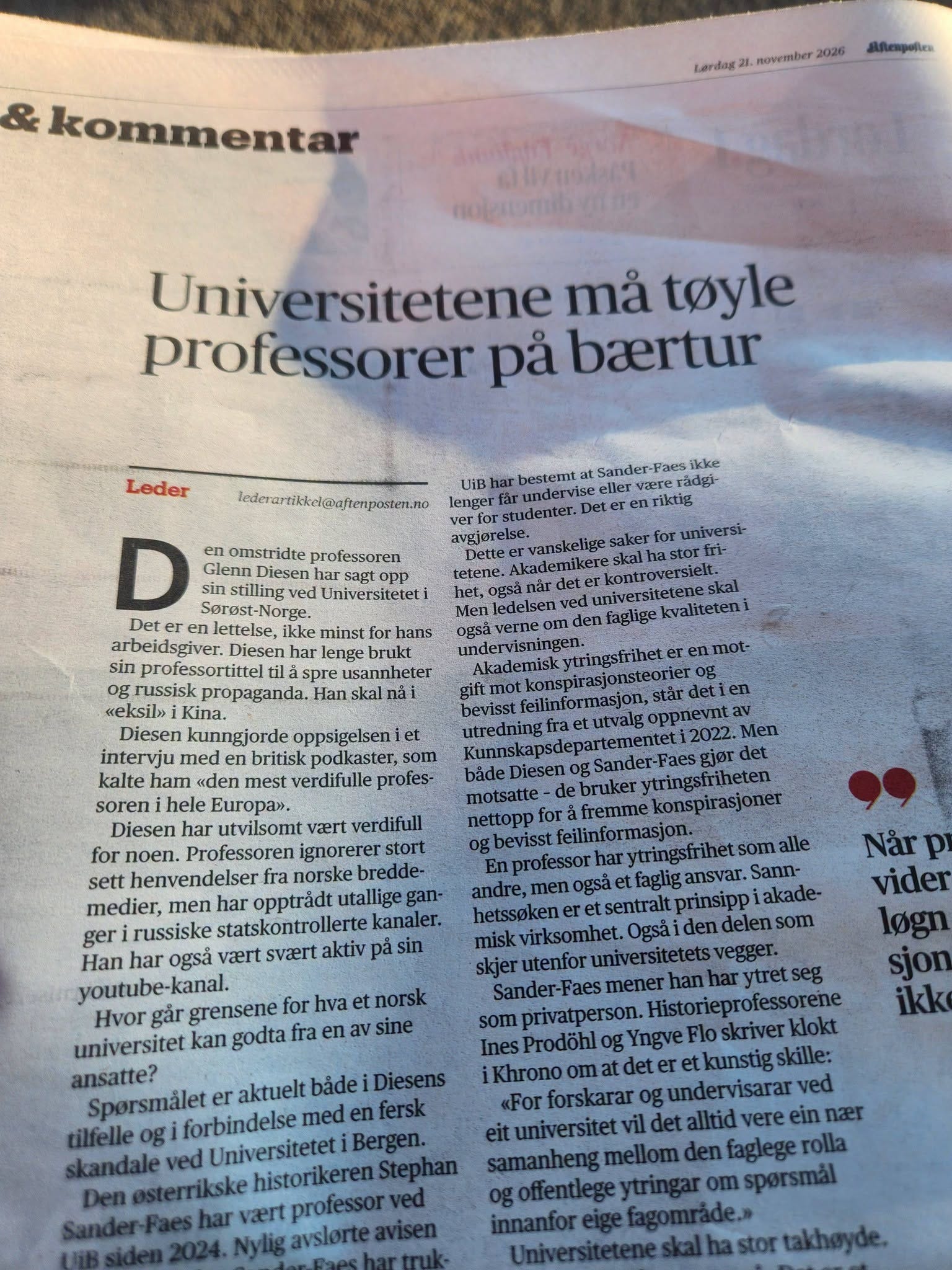
GLENN DIESEN: MORTE DA LIBERDADE ACADÉMICA NA NORUEGA
Comentário de Manuel Banet:
O terrorismo ideológico exercido por alguns jornalistas «por encomenda», estende-se porém a muitos elementos da sociedade, não apenas ao destacado académico Prof. Diesen. É que a quantidade de pessoas que encolhem os ombros e continuam a engolir as mentiras e distorções, torna-se crítica.
O Prof. Diesen vê-se obrigado a deixar o seu posto universitário e ir para outro país. A Noruega onde ele cresceu e onde se tornou figura pública, já desapareceu. Não é caso único, pois a liberdade académica em muitos países do espaço europeu, também deixou de ser o último refúgio para o livre debate de ideias. Nem sequer esse espaço académico de liberdade é tolerado. Os novos censores precisam de humilhar, difamar e perseguir quem não esteja de acordo com a campanha de russofobia e preconceitos. A identificação das atuais tendências governativas na Europa com o novo totalitarismo é, infelizmente, perfeitamente adequada:
ttps://glenndiesen.substack.com/p/the-death-of-academic-freedom-in
The Death of Academic Freedom in Norway
Prof. Glenn Diesen
Glenn DiesenNorway’s largest print newspaper, Aftenposten, argued this week that I should not be allowed to teach at a Norwegian university. Why? They accuse me of lying and spreading conspiracy theories. Do they need any evidence for this character assassination? None at all. Instead, they attempt to justify it by comparing me to a Holocaust denier for no apparent reason. This is the new standard of journalism in Norway: journalists cite the smears of their colleagues and refer to government “fact-checks” that they cannot / refuse to defend. As they cannot find any incorrect facts, they have to accuse me of spreading a “narrative” similar to the Kremlin, or being “pro-Russian” as I argue for diplomacy instead of sending more Ukrainians to their deaths in a proxy war against the world’s largest nuclear power. There is nothing that can be done. They can make any absurd claims because nobody will come to your defence for fear of being caught in the line of fire. When the political-media establishment comes for you, you are truly all alone.
And why should I not be allowed to teach in Norway? I previously taught Russian security strategy, military studies, international relations theory, and political economy for nine years in Australia and Russia. However, I would never even consider teaching a class in Norway in which I had to mention the word “Russia,” as journalists would inevitably find something that deviates from NATO’s official truths and could thus be labelled as “Russian propaganda.” During my first year teaching in Norway, I was contacted by a Norwegian journalist investigating me for spreading Russian propaganda in the classroom. The allegations were easily dismissed, as I was teaching research methods and had never mentioned the word “Russia” in the classroom. For the past six and a half years, I have been teaching sociology and research methods, as it is difficult for Norwegian journalists to cancel someone for spreading “Russian propaganda” when they are teaching Max Weber and Émile Durkheim.
Ignoring inquiries?
The newspaper also had the audacity to write: “The professor largely ignores inquiries from mainstream Norwegian media outlets.” Absolute nonsense. What inquiries have I ever received from Norwegian journalists? Over the past 6.5 years, I have been contacted approximately 25-30 times to respond to accusations of being “controversial”, “pro-Russian”, “pro-Georgian”, “pro-Iranian”, “pro-Chinese”, a “propagandist”, or “spreading Kremlin narratives”. My engagement with the media has been reduced to being allowed to respond to smears and labels that are never backed up by any evidence. Consequently, every media inquiry produces headlines along the lines of Professor Diesen “denies” spreading Russian propaganda or Professor Diesen “denies” being paid by the Kremlin. What is there to deny when there is never an argument or any evidence to address?
During the past 6.5 years, I have only once been asked for my opinion on a political issue, back in 2022. The newspaper was subsequently pressured by the mob into apologising and even published an article thereafter arguing that it should have informed the public that I was “controversial”. They had the opportunity to challenge my arguments during the live interview but did not. They never explained what I had said that was wrong, nor did they give me an opportunity to defend myself against their denunciation. Since then, even the Defence Minister cautioned the two podcasters against speaking with me as I was accused of spreading “Russian propaganda” by arguing (and documenting) that NATO expansion provoked the Ukraine War. So I ask again, what inquiries have I ever ignored? The journalists are eagerly shaping the narrative of my resignation, not reporting on reality.
The campaign after I resigned
I initially considered taking a temporary break and asked my university for one year of unpaid leave to get away physically and escape the headlines. As I wrote to my university, I requested “one year of unpaid research leave to conduct research within my core area of expertise, with the application further supported by additional circumstances, including death threats, harassment in the workplace, and other challenges that have made it necessary to withdraw my children from school and sell our house”. My application was rejected without any explanation and with no interest in even addressing the documented harassment in the workplace. After I was left with no other option but to submit my resignation from the university, I thought that at least we would get some peace by permanently ending my employment in Norway.
However, over the past week, no fewer than 15 Norwegian media outlets have published hit pieces about me, and not a single one could point to anything specific I have actually argued. Yet, there was no shortage of meaningless labels and citing of unsubstantiated smears. I am baffled by the intensity and absurdity of it all, especially since these articles are all based on reporting that I have already resigned from my position as a professor at the university.
They have already won… The endless smears, censorship, threats, and intimidation worked — yet they still do not stop. This new campaign seems intended merely to ensure that I leave the country completely discredited.
While it is extremely sad to be pushed out of the country and pressured into exile, I take some comfort in knowing that, in a few weeks, I can return to normal teaching and a normal life beyond this Norwegian bubble of warmongering, disinformation, and censorship where academic freedom goes to die.
Subscribe to Glenn Diesen’s Substack
sábado, 21 de novembro de 2026
A Cimeira de Shenzhen da APEC, a guerra e a paz [Crónica da III Guerra Mundial, nº76]
Nestes dias de cimeira, 18 e 19 de Novembro, em Shenzhen, a muito visível «dança protocolar» centrada no anfitrião (Xi Jinping) e nos seus dois convidados especiais, Donald Trump e Vladimir Puitin, não produziu um resultado notável aparente. Mas, só aparentemente. As decisões não publicitadas costumam ser as que realmente contam.
O papel estabilizador do comércio
No tempestuoso século XXI, a estabilidade relativa nas relações internacionais é sobretudo devida a laços e acordos comerciais, pois a economia globalizada tem necessariamente de ser aberta. Se muitos países são dependentes das exportações para equilibrar sua balança comercial e obter um excedente líquido para investimento, estes países não têm interesse em atiçar conflitos, em provocar rupturas. Estão nesta categoria os países do Sudeste Asiático, que têm relações comerciais estreitas entre eles e com a Rep. Popular da China, apesar de alguns serem alinhados militarmente com os EUA, caso da Coreia do Sul e das Filipinas. Mesmo estes, não deixam de fortalecer os laços com o gigante vermelho, que lhes proporciona um grande mercado para os seus produtos. No caso da Coreia do Sul, estão implantadas fábricas desde há vários anos, com produção de alta tecnologia e alto valor acrescentado.
O «partido» europeu da guerra
Por mais que os governos europeus, liderados pelas «gémeas políticas» Úrsula Von der Leyen e Kaja Kallas, se esforcem por provocar o alargamento da guerra contra a Rússia, não têm conseguido os seus intentos. A sua última provocação foi, durante a cimeira, um ataque «ucraniano» à ponte que liga a Crimeia ao resto do continente. Nestes ataques, colaboram ativamente as potências europeias da OTAN com armas sofisticadas, que as forças ucranianas não possuem: Os satélites militares (para guiar os mísseis de modo preciso para o alvo), os sistemas de lançamento (implicam equipas militares especializadas) e a produção de mísseis (de fabrico britânico, alemão ou francês). É, portanto, claro que a escolha deles é a guerra. Igualmente, mostram seu belicismo, na sua insistência com o regime de Kiev, para este tomar posições inflexíveis, não possibilitando que os contactos preliminares entre os beligerantes, se transformem em conversações de paz.
Estamos a viver momentos contraditórios, em que Donald Trump não está interessado em arrastar a guerra na Ucrânia. Por outro lado, situação interior deste país evolui, com expressões de descontentamento e manifestações pelo fim da guerra. Porém, a guerra é a última esperança a que se agarram os pigmeus políticos* dos países da UE, a Alemanha, o Reino Unido, a França. Desesperados, os líderes destes países estão a espezinhar literalmente a vontade dos seus povos, as suas constituições respectivas e só lhes resta reprimir violentamente manifestantes pacíficos, tal é a popularidade da sua política internacional. Mas eles continuam, pois são políticos do sistema; vão perder as próximas eleições, mas ficam «em reserva». Continuarão a servir como lacaios do grande capital, se tiverem oportunidade.
---------------------
* Com uns lamentáveis fantoches, como o figurante português António Costa, para encenarem uma unidade política fictícia!
PS: COMPLEMENTO DE INFORMAÇÃO
quinta-feira, 19 de novembro de 2026
INTELIGÊNCIA ARTIFICIAL - A PIOR INIMIGA DAS PRÓXIMAS GERAÇÕES
Não é o «Chat-GTP», ou outros sistemas da IA, que vão ensinar as crianças a ler, a raciocinar, a focalizar a sua atenção num problema. Estas são aprendizagens que resultam de uma visão humanista da educação. As crianças precisam de exercer o seu esforço físico e mental, para solucionar os pequenos e grandes problemas que encontram pela vida fora. Os sistemas de IA funcionam em sentido contrário, pois, como dizia uma aluna: «Para que vou aprender a ler, se a IA vai ler para mim?», «para que vou preocupar-me em resolver um problema, se a IA o faz para mim?».
Os pais mais afluentes da população americana já compreenderam quais os efeitos de entregar as suas progenituras a sistemas IA: Inscrevem-nos em escolas com ensino tradicional, não lhes dão, nem deixam brincar com, «smartphones», «tablets», etc. e apenas têm acesso a estes gadgets, quando já estão na escola média, a partir dos 14 anos.
Como disse um senhor, o último dos entrevistados, estamos a produzir uma geração incapaz de fixar a atenção, de memorizar dados úteis para a vida e que terão muita dificuldade em adaptar-se às tarefas do trabalho, seja em que sector for.
Eu acrescento que a transformação dos jovens em seres passivos, viciados em Internet e jogos de computador, é realmente o que desejam os Mark Zuckerberg, os Sam Altman, etc.. Querem para o seu modelo de sociedade: Uma pequena elite, com alguns «criativos», as quais têm ao seu serviço uma mole de pessoas robotizadas, ou mesmo, robots. As restantes, embora capazes fisica e mentalmente de trabalhar, mas sem emprego, ficam a sobreviver com o «rendimento básico universal».
Tenho lido estimativas de que na sociedade robotizada, onde a IA domina, haverá cerca de 80% marginalizados, que não encontram trabalho compatível com as exigências do tecnofeudalismo.
LEITURAS COMPLEMENTARES:
quarta-feira, 18 de novembro de 2026
O CAOS NA ERA DA IA (prof. JIANG)
O prof. Jiang tenta racionalizar as diversas falhas do sistema, enumerando as falhas e as suas causas: financização, burocratização, envelhecimento da população
Colapso sistémico.
Subscrever:
Mensagens (Atom)